


How to Spot a Fake Travel Itinerary Before It Becomes a Fraud Problem
May 19, 2026
Fake travel itineraries can slip into visa files, claims, onboarding flows, and compliance reviews. Learn the red flags, verification steps, and how Bynn helps detect forged travel documents.
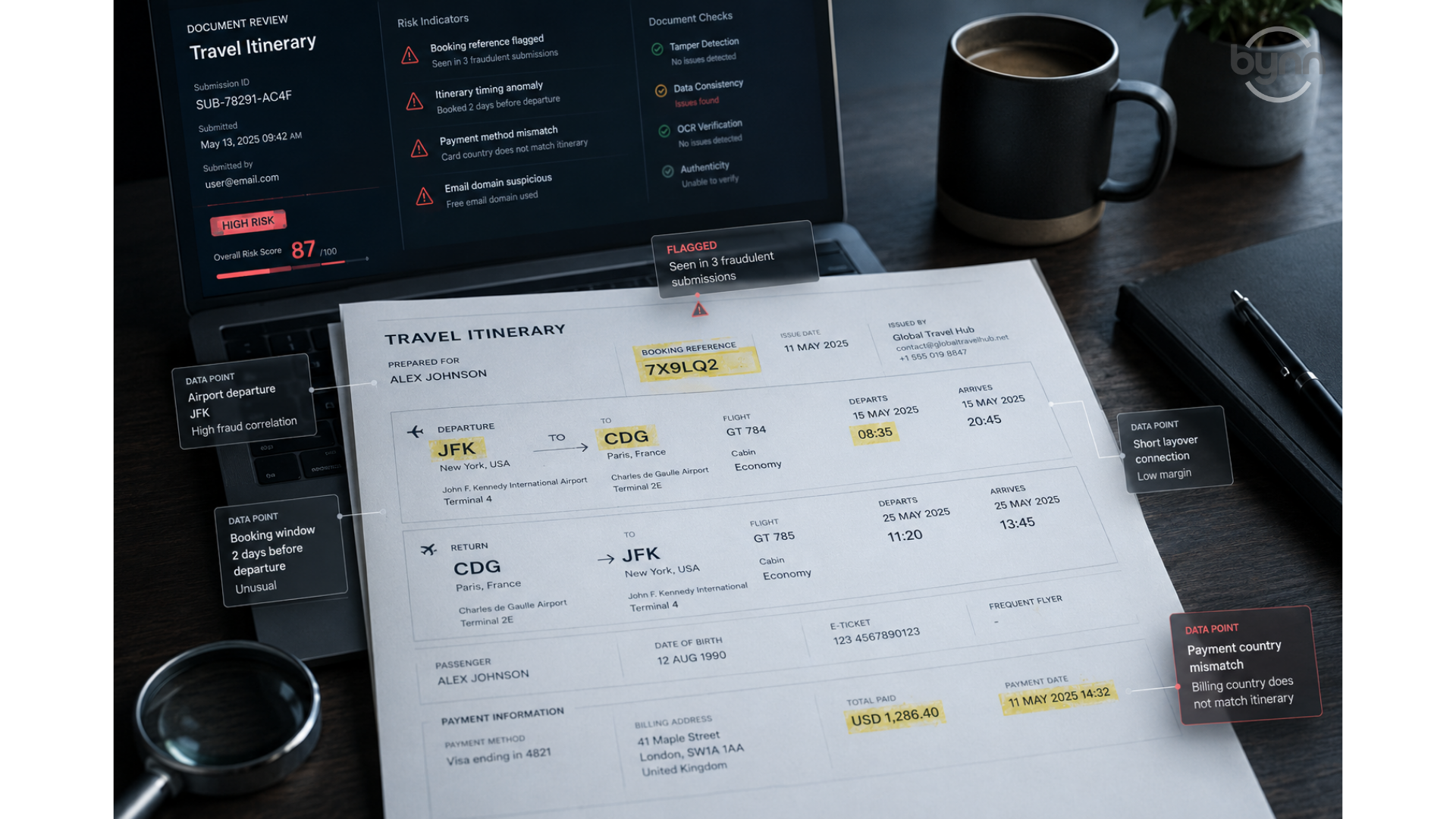
How to Spot a Fake Travel Itinerary Before It Becomes a Fraud Problem
A polished itinerary can still be a fabricated risk signal that distorts decisions across onboarding, claims, and compliance.
A fake travel itinerary is rarely just a fake travel itinerary. In practice, it is a credibility test wrapped in a PDF: a document that can influence visa-related reviews, support a reimbursement claim, reinforce a customer narrative during onboarding, or help a suspicious case appear routine. That is why surface-level review is no longer enough. We need to understand what kind of travel record we are looking at, whether its contents make operational sense, whether the file behaves like a real document, and how it fits into the wider risk picture. When we do that well, flimsy visual fraud starts to look much less convincing.

Why fake itineraries matter more than they appear to
Travel documents still carry weight in real-world workflows. A travel itinerary is a document that confirms a traveler's arrangements, including flights, a hotel stay, and events, and embassies and consulates often request it during visa applications to verify intent and plans to leave after a visit. In lower-friction processes, reviewers may treat itineraries as background material. In higher-risk cases, they can become part of the trust decision itself.
That is exactly why fraudsters use them. A forged itinerary is attractive because it looks ordinary. It does not announce itself as a high-risk artifact. It arrives dressed as admin. Neat layout. Familiar fields. Airport codes. A booking reference. Maybe even a barcode-like visual element. The hope is simple: if the document feels routine, the reviewer will scan it, not test it.
The downstream impact can be larger than the document suggests. A false itinerary can support a fabricated travel story by showing realistic route, flight, or accommodation details without a fully paid booking, which can make it look plausible to travelers and reviewers alike. It can make an identity profile feel more coherent than it really is. It can be used to justify urgency, explain geographic anomalies, or pad out a weak case file with something that looks official. In claims and expense workflows, it can support reimbursements that should never be approved. In onboarding, it can help a synthetic or manipulated profile appear stable. In compliance, it can distract attention from the broader signals that matter more.
Know what kind of flight itinerary or travel document you are actually looking at
One of the most common review errors is treating all travel paperwork as interchangeable. It is not. A reservation or itinerary, an e-ticket, and a boarding pass belong to different stages of the travel lifecycle. If we collapse those categories, we make fraud easier to miss.
A reservation, often linked to a PNR or record locator, reflects a booking state. It may show the traveler’s name, flight segments, dates, and route information. It may exist before payment is finalized, and it may exist before a ticket is issued. A dummy ticket is typically a temporary flight reservation used for visa applications or proof of onward or return travel without buying a confirmed flight ticket. That kind of placeholder can help travelers submit required documents while keeping plans flexible. That matters. If a document claims to be an itinerary or reservation, it does not automatically need to behave like a paid ticket.
An e-ticket is different. It is tied to ticket issuance. It is not just a trip summary; it is evidence that a ticket exists in the airline system. A real ticket usually includes distinct ticket numbers, which temporary reservations or placeholders do not have, and that changes its relationship to fare details and payment completion. A reservation can be plausible without every ticketing field. A ticket cannot be plausible if it ignores the logic of ticket issuance.
A boarding pass comes later still. It is associated with check-in, not just booking, and it is the document used to board. That timing matters more than many reviewers realize. If a file claims to be a boarding pass but everything else in the case suggests the traveler was only at the reservation stage, the problem is not cosmetic. It is chronological. A forged document often tries to be too complete, too early, because the forger is optimizing for visual credibility rather than process accuracy.
Where forged itineraries usually give themselves away
Formatting and layout problems are still useful, but only if we read them correctly. A fake itinerary may look polished from a distance and fall apart up close. Alignment drifts. Typography changes subtly between sections. Varying font sizes, mismatched colors, and other inconsistent formatting are common warning signs, and the fine print may also contain impossible time zones or disclosure styles that do not match the rest of the page. Labels feel generic rather than operational. Small-print disclosures look too thin, too clean, or oddly incomplete. Airlines, embassies, and border control officers may treat that kind of visual inconsistency, along with missing ticket-stage indicators, as evidence of a fraudulent document. Real travel documents are often dense, repetitive, and slightly inelegant because they are system-generated artifacts. Fakes are more likely to be designed as impressions of those artifacts.

Misleading or mismatched information is the next layer. A real-looking flight number attached to an implausible route. Airport codes that do not resolve the way the document suggests. Issuer details that do not fit the airline style or booking context. A booking reference that looks official but behaves strangely when compared with how airline confirmations are usually structured. Even basic flight details, destination entries, or claims about what type of plane serves a route can often be disproven with a quick search. Fraudsters often get close enough to feel credible while missing the exact relationships between fields.
Pricing and math anomalies are another strong signal. This is where a forged document that looks excellent visually can become surprisingly weak. Totals may not reconcile with fare components. Taxes may appear unnaturally rounded. Currency formatting may change within the same page. A fee line may be included simply because it “looks right,” not because it belongs in that pricing scenario. We should be especially cautious when the financial structure of the document feels decorative rather than computational.
Internal timeline and logic contradictions matter just as much. Dates should move in one direction. Issue timing should make sense relative to departure timing. A check-in-stage document should not appear in a narrative that has not reached check-in. A route should be plausible not only geographically, but within the sequence the document claims, including any stated arrival sequence. Forged files often fail here because they are built from fragments of familiar travel language stitched into a single PDF, often through online template-based edits rather than genuine system exports, without respect for the operational order of events.
File and metadata anomalies are the most underused clues in the review process. The visible page is only part of the document. The file itself may reveal recent creation or modification patterns, odd author values, nonstandard producer information, or other signs that the document was manually assembled or edited rather than generated through a normal travel workflow. AI can also flag pixel-level errors and logical contradictions that manual review may miss. Metadata is not a magic answer. But when it conflicts with the story the file is trying to tell, it becomes a serious reason to pause.
The manual checks that separate guesswork from review
Good manual review starts with a shift in mindset. We should stop asking only whether the document looks authentic and start asking whether it behaves like the document type it claims to be. That change sounds small. It is not. It moves the review from aesthetics to structure.
Code validation is a practical first step. Airline and airport codes should resolve cleanly and support the route being presented. If the itinerary says one thing and the codes imply another, we have a concrete inconsistency. The same is true of place names, terminals, and route sequencing. When shown, flight numbers should also align with the stated reservation stage, as should arrival times, arrival dates, and gate information. Travel records are built around operational precision. Sloppy mismatches matter.
Confirmation behavior deserves similar attention. A PNR or booking reference should feel plausible in its format and role. It is not enough for a code to look short, uppercase, and “airline-like.” If a document is presented as a genuine temporary reservation, a valid PNR should be verifiable on the airline website or the airline's official booking channels. It should fit the surrounding context of a reservation rather than floating inside the document as a prop. We are not trying to reverse-engineer an airline system from a screenshot. We are checking whether the document’s logic holds up under basic scrutiny.
Ticket-number logic is another powerful filter. If the file presents itself as a paid e-ticket, ticketing details should exist where that claim would normally require them. If the document presents itself as a reservation, the absence of some ticket-stage detail may be entirely normal. The key is consistency between label and content. Fraud review gets sharper the moment we stop demanding every field on every document and start testing the correct fields for the stage being claimed.
Check-in and boarding timing can also expose weak forgeries very quickly. A boarding pass implies a later moment in the journey than a simple itinerary. If the case narrative, timestamps, and document stage do not line up, we should treat that as more than a minor inconsistency. Fraud often hides in the assumption that nobody will test chronology.
Finally, PDF metadata should be part of the standard review habit, not a niche technical step. A valid travel itinerary can confirm booked flights and hotel reservations, which is why it is often treated as trusted proof in operational reviews. Author name, creation date, modification date, producer information, and related file properties can tell us whether the document looks system-born or hand-worked. Metadata will not replace document analysis, but it can sharpen it. A polished page paired with suspicious file properties is often more revealing than the visible layout alone.
Why layered, risk-based verification changes the outcome
The weakness of purely manual review is not that it never works. It is that it works unevenly. Strong reviewers catch what weaker reviewers miss. Low volumes are manageable. Higher volumes are not. And once fraudsters realize a process relies on visual intuition, they adapt fast. For temporary PNR reservations, a legitimate travel agency or verified dummy-ticket service is a safer source than fabricated files.
That is where layered verification makes the difference. With Bynn, a suspicious itinerary does not need to be judged in isolation. It can be tested through document forensics, metadata review, and cross-field consistency analysis, then evaluated against the wider case context. That context matters. A questionable itinerary attached to an otherwise coherent, low-risk profile is one scenario. The same itinerary appearing alongside identity friction, sanctions exposure, adverse screening results, business-ownership uncertainty, or behavioral anomalies is another. Some travelers use a dummy ticket to avoid losing money on a non-refundable booking while a visa decision is pending, rather than pay for a full fare too early. It may help satisfy visa requirements, but it does not guarantee approval. Many embassies and consulates ask for proof of a travel path, such as an onward ticket, return ticket, or round trip ticket, to assess whether the applicant plans to leave after the visit; in many countries, proof of onward travel may also be checked by airline or immigration staff before boarding or entry.
This is the value of a risk-based approach. We do not need to treat every travel document as a crisis, and we do not need to trust every polished PDF because it looks familiar. We need to allocate scrutiny intelligently. Bynn helps us do that by combining document analysis with KYC, KYB, AML controls, and contextual risk scoring. The result is a better decisioning model: faster where the risk is low, deeper where the exposure is higher, and less dependent on whether an individual reviewer happens to notice a subtle contradiction on page one.
What good practice looks like from here
A fake itinerary becomes dangerous when we let appearance stand in for verification. Better practice is more disciplined and more practical. First, identify the document stage: reservation, e-ticket, or boarding pass. Then test whether the fields match that stage. Validate the codes, examine the booking logic, review pricing coherence, pressure-test the timeline, and inspect the file itself. Presenting fake or doctored travel documentation to immigration or embassy officials is illegal and can lead to visa denial, deportation, or future travel bans. If you create a legitimate temporary reservation, fill details exactly as they appear on the passport so the passenger record supports a planned visit to the country. After that, zoom out. Ask what the document means inside the full customer or case context.
That is the real standard. Not “does this look real?” but “does this hold together?” Ask whether the travel plan, travel time, and passenger information support the claimed journey and fit the stated travel plans. When we apply that standard consistently, fake travel itineraries stop being clever paperwork and start revealing themselves for what they are: early warning signals in a larger fraud story.