


Picture-First Document Workflows Are Creating a New Fraud Blind Spot
May 20, 2026
Businesses often accept screenshots, scans, and phone photos because they are easier to collect. But when native documents become pictures, important integrity signals can disappear. Here is why companies now need AI that can inspect both images and PDFs in the same fraud workflow.

When a Native Document Becomes a Picture, Document Fraud Detection Gets Harder to See
Businesses are making document collection easier. They are also, often without realizing it, making document verification weaker. Across onboarding, proof-of-address, underwriting, supplier checks, and compliance workflows, screenshots, scans, phone photos, and print-to-PDF files are increasingly accepted because they reduce friction and work well on mobile. But when a born-digital file is replaced by a picture-like copy, some of the strongest integrity signals can disappear. That is no longer a minor technical detail. It is a growing fraud problem.
When a native document becomes a picture, businesses may gain convenience, but they often lose provenance, structure, and high-confidence integrity signals, making it more difficult to detect fraud in documents. So the modern answer is AI models that can forensically assess both images and native documents inside the same verification workflow. This shift in document submission formats presents unique challenges for the document verification process, as the loss of structural and metadata information hinders traditional verification methods. To effectively detect fraudulent documents, organizations must leverage advanced technologies that combine optical character recognition (OCR), metadata analysis, and pixel-level forensic techniques. These AI-driven models not only analyze the visible content but also scrutinize underlying document features such as document structure, embedded signatures, and digital watermarks, which are often absent in image-based submissions, which would be make it more difficult for most document fraud detection softwares to detect potentially fraudulent documents. Furthermore, integrating contextual analysis enables the system to cross-reference extracted data against authoritative sources like government agencies and financial institutions, enhancing the accuracy of fraud detection. As fraudulent activity becomes more sophisticated, employing a multi-layered document verification process that handles both native and image formats is essential for maintaining compliance, mitigating risk, and preserving customer trust in business operations.
The Shift to Picture-First Workflows
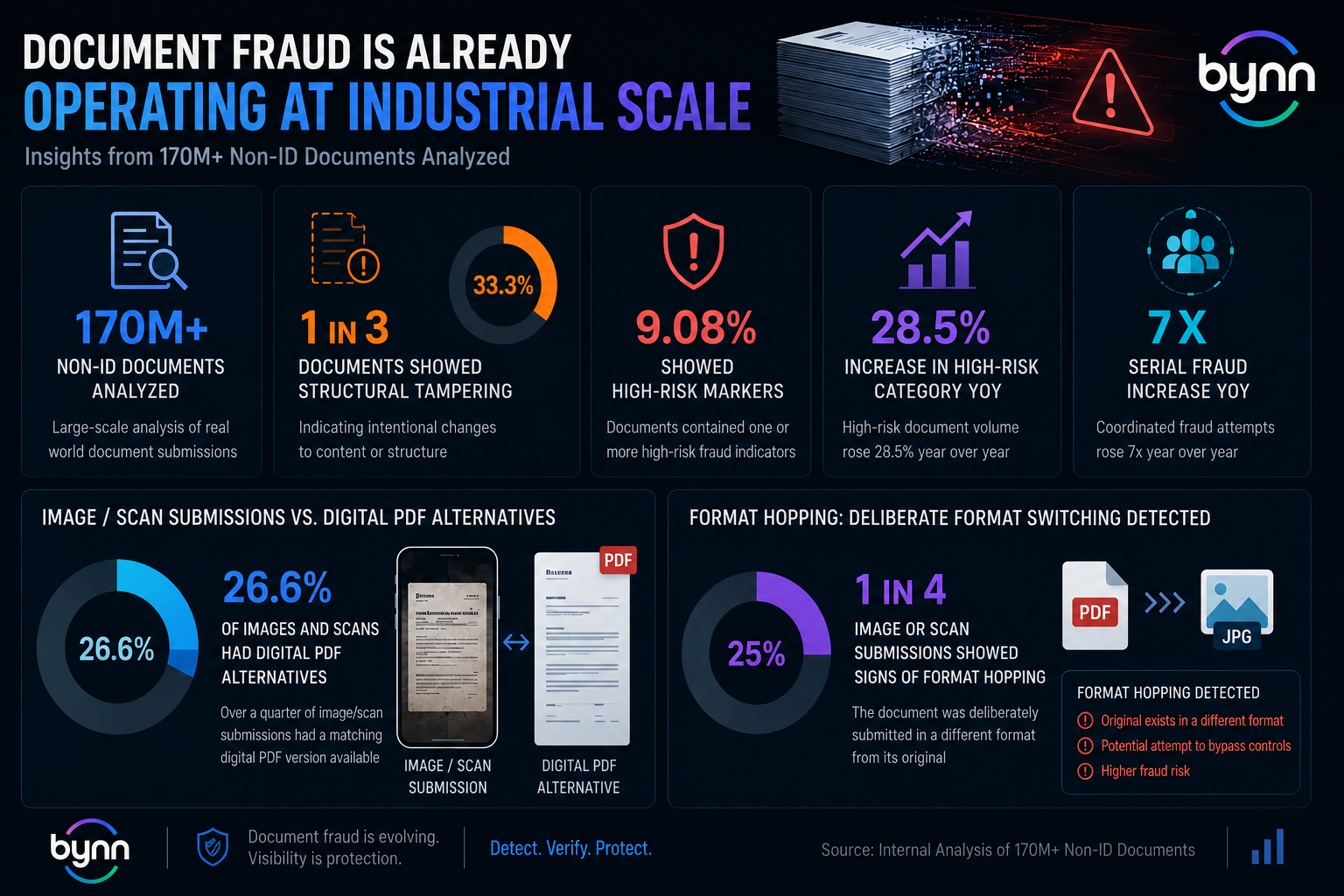
The real change is not that PDFs have stopped mattering. It is that many businesses now tolerate, and sometimes implicitly encourage, picture-first submissions because they are easier to collect from customers on phones. A 2026 industry report built on 170 million+ non-ID documents found that document fraud is already operating at industrial scale: 1 in 3 documents showed structural tampering, 9.08% showed high-risk markers, that high-risk category rose 28.5% year over year, and serial fraud increased 7x year over year. Those are not the numbers of a niche back-office annoyance; they reflect the unauthorized creation, alteration, or malicious duplication of official records to deceive individuals or organizations. Globally, that financial impact is estimated at roughly 5% of annual revenues, or about $5 trillion. In North America alone, losses have exceeded $10 billion in recent years, driven largely by identity theft and counterfeit documents. They describe a live operational risk for modern businesses.
The same report shows why picture-first workflows deserve closer scrutiny. It states that 26.6% of images and scans had digital PDF alternatives, and that 1 in 4 image or scan submissions showed signs of format hopping, meaning the document was deliberately submitted in a different format from its original. At the same time, the report is careful not to overclaim: just because a document is a screenshot or scanned doesn't mean that it is a fraudulent document, and some users genuinely do not know how to download the native file. That nuance matters. The business issue is not that every image is fake. For financial institutions, the cost of addressing fraud rose from $3.64 per dollar of fraud in 2020 to $4.41 in 2023, a 21% increase that shows the operational stakes. It is that the shift toward pictures increases ambiguity exactly where businesses most need confidence.
What Disappears When a PDF Becomes a Picture in Document Fraud
A native PDF is not just a flat image of a page. Adobe’s Acrobat documentation explains that PDF properties can include security settings, font information, initial view settings, and custom properties, while PDF metadata can include creation dates, modification dates, extended schemas such as Dublin Core and IPTC, and application-specific metadata, including who created the file, when it was last modified, and what software generated it. The Library of Congress describes PDF as a structured, page-oriented format that can contain text, images, graphics, multimedia, annotations, metadata, hypertext links, and bookmarks. It also notes that, beginning with PDF 1.4, PDF files can include XMP metadata streams at the document level or even for individual objects.
That structure matters because it creates evidence. PDF Association documentation notes that digital signatures can be embedded directly within PDF documents, and Adobe says certified PDFs can be used to authenticate content, enforce document integrity, and specify which changes remain permissible after certification. The PDF format also supports revisions and incremental changes over time, which is one reason version-aware inspection can reveal far more than the final visible page suggests. A picture, by contrast, usually preserves appearance while discarding context. For document authenticity, the most reliable validation comes from cryptographic hashes or blockchain-verified records because they provide a binary check without relying on human judgment.
The forensic consequence is straightforward. When a native PDF is flattened into a screenshot, a photo, a scan, or a print-to-PDF derivative, the reviewer may lose direct access to the original document’s metadata, XMP streams, signature context, logical structure, font-level clues, and revision history. If the native file is preserved, metadata analysis can still reveal signs of PDF editors, mismatched generation software, or altered timestamps. The 2026 fraud report makes this point bluntly: scanned PDFs and images are never the original documents, the conversion process destroys evidence, and the signals available from analyzing a PDF are either weaker or simply gone after conversion. That is why a picture-first submission is best understood as a forensic downgrade, not merely another upload format. Keeping native files also makes it easier to verify the data contained in extracted text against issuing registries or government databases.
Images Still Carry Clues
None of this means images are signal-free. They are not. Bynn’s documentation describes EXIF-based analysis for image documents, including camera information, editing-software traces, GPS location data, and timestamp consistency. Some document fraud detection software also uses Environmental Fingerprinting during upload to intercept background signals and flag anomalies such as hidden IP addresses, device configurations, or unusual copy-paste behavior. Those clues can be highly valuable, especially when the only available evidence really is a photo or scan. But EXIF is a different evidence layer from native PDF structure. It may say something about capture and editing. It does not restore the original born-digital object that has already been flattened away. That is why images can still be useful while remaining, in many born-digital cases, a weaker basis for trust than the native file they replaced, and these checks can help catch fake documents before contracts, invoices, or ID papers move further into review.
Moreover, images can reveal subtle inconsistencies not immediately apparent in native documents. For example, pixel-level analysis can detect anomalies such as inconsistent compression artifacts, unexpected color variations, or signs of digital manipulation like cloning or splicing. These forensic techniques are crucial in identifying document forgery attempts where fraudsters may alter specific sections of an image to misrepresent information. Additionally, natural language processing (NLP) can analyze the extracted textual content from images to detect logical inconsistencies, mismatched data fields, or improbable dates and figures, which often signal fraudulent expense claims or fabricated financial documents.
Furthermore, the integration of AI-driven data extraction tools enhances the ability to analyze documents efficiently, whether native or image-based. These tools can extract structured data from bank statements, utility bills, medical records, and other financial documents, enabling cross-verification with authoritative databases and fraud pattern detection. This capability is vital for fraud prevention as it allows organizations to quickly identify suspicious documents that may be part of sophisticated fraud attempts involving forged identity documents or digital document fraud.
In the broader fraud landscape, combining image-based forensic analysis with contextual and behavioral data—such as user submission patterns and device fingerprinting—provides a comprehensive risk mitigation strategy. This multi-layered approach reduces false positives and improves the accuracy of fraud investigations, ensuring that genuine documents are processed smoothly while fraudulent ones are flagged promptly. As fraud tactics evolve, especially with the rise of AI-generated synthetic documents, leveraging all available signals from images alongside native document features becomes indispensable for maintaining robust document verification solutions and protecting business processes from huge financial losses.
Why Format Hopping Raises Risk
Format hopping deserves more attention than it usually gets. In the 2026 report, it is defined as the deliberate evasion tactic of submitting a document in a different format than its original. The examples are telling: a PDF turned into a pristine JPEG, a browser-generated print-to-PDF instead of the original download, and screenshots that recreate the visible page but inherit none of the source file’s structural properties. In other words, format hopping is not just a convenience artifact. In many cases, it is a way of changing the evidence object before it reaches the reviewer.
To prevent document fraud, organizations need multiple verification layers rather than purely manual review. The same report warns that the apparently lower fraud rates in scans and images are undercounts, not signs of safety, precisely because so much signal is lost during conversion. The most effective way to detect document fraud is AI-driven document forensics using multi-signal analysis across pixel-level analysis, metadata analysis, and contextual analysis. A document can look clean after being flattened. That does not mean it was clean before being flattened. For businesses, this is the trap: the submission may appear simpler, more universal, more customer-friendly. In reality, it may be less transparent and therefore harder to verify with confidence. AI can compare submissions against legitimate documents or document templates to spot reuse and pixel-level inconsistencies in seconds.
Metadata Analysis Helps, but Metadata Alone Cannot Decide
Metadata absolutely matters. The 2026 report says high-risk documents are more than five times as likely as normal documents to have stripped metadata. That is useful. It is also incomplete. Metadata absolutely matters, but common red flags also include typography inconsistencies, pixelated or distorted logos, impossible dates, and missing metadata. The same report warns that relying on metadata alone is doomed to fail because professional fraudsters can produce documents with plausible metadata, while legitimate issuers may use tools such as Acrobat or Photoshop in perfectly valid workflows. In short, metadata can raise questions, but it rarely answers them by itself.
That is exactly why layered detection matters. The same report says combining multiple detection layers catches 40% more fraud than relying on any single method alone. Bynn’s documentation follows the same logic: its document fraud system combines content analysis, metadata examination, version history, embedded code validation, digital signature verification, database checks, pixel-level analysis that can identify anomalies through Error Level Analysis when regions show different compression levels, and natural language processing to cross-check logical coherence across fields because no single method can catch all fraud attempts. For businesses, that is the modern lesson. Authenticity is no longer a one-signal problem. It is an evidence stack.
The broader provenance movement points in the same direction. C2PA defines Content Credentials as an open standard for establishing the origin and edits of digital content, and Adobe describes Content Credentials as a durable, industry-standard metadata layer that can disclose whether content was captured by a camera, generated by AI, or edited in software. C2PA’s specification even includes soft-binding mechanisms, such as invisible watermarks or fingerprints, to help recover manifests when metadata has been stripped. That is an important signal from the market itself: provenance is becoming more valuable precisely because provenance is so often lost in ordinary distribution and upload flows.
The Fraud Detection Problem Is Now Multimodal

The next wave is not just altered documents. It is synthetic documents, synthetic images, and synthetic identity signals arriving together. The 2026 report says that about 5% of fraud declines in its adaptive sample came from AI-generated documents and that detections of AI-generated documents increased 90x from 2024 to 2025; here, artificial intelligence and machine learning help identify patterns from both supervised models trained on millions of labeled transaction histories to isolate historic fraud traits and unsupervised models that isolate mathematical outliers, including brand-new vectors or AI hallucinations within data fields. The same report also describes professionalized tactics around metadata stripping, format hopping, automated generation pipelines, and quality-check loops. Fraud is no longer confined to clumsy edits. It is becoming faster, cheaper, and more systematic.
That is where the problem becomes decisively multimodal. World Economic Forum materials on deepfake-resistant identity verification explicitly frame face swapping and camera injection as major attack types, showing that modern fraud increasingly spans documents, faces, and live verification streams rather than one file in isolation, including binding identity documents to the physical user through face matching and active presentation-attack detection. Bynn’s own platform architecture mirrors that reality: document forensics sits alongside biometric verification, liveness detection, AML screening, and an AI-driven decision engine. A business that inspects only the document but not the person, or only the person but not the document, is defending yesterday’s attack surface.
Why Bynn Fits This Document Verification Moment
This is the context in which Bynn’s capabilities make sense. Our system analyzes PDF and image documents using AI to examine metadata, text structure, embedded signatures, and signs of manipulation. Our documentation adds the important technical detail: PDF metadata examination, EXIF analysis for image-based documents, PDF version recovery, object- and content-level comparison, digital signature validation, AI deepfake and generation detection, and confidence scoring for synthetic content. Manual review is slow, error-prone, and resource intensive by comparison, while AI-powered document fraud detection software scales far better. That is exactly the kind of cross-format forensic stack businesses now need.
Just as important, Bynn does not stop at the file. Our platform overview and onboarding documentation describe a workflow that connects document verification to biometric analysis, liveness detection, KYC and KYB checks, AML screening against sanctions, PEPs, and adverse-media sources, proof-of-address handling, and automated decisioning. Organizations also struggle to analyze unclassified files across more than one document type, varying formats, and inconsistent image quality inside document processing workflows. That matters because the rise of picture-first submissions is not just a file-format problem; it is a workflow-integrity problem. Businesses need a system that can evaluate the evidence object they receive, understand what was lost when formats changed, and place that finding inside a broader risk decision.
The practical takeaway is simple. Businesses do not need fewer document formats. They need better intelligence across formats. When a native PDF exists, preserve it. When only a screenshot, phone photo, scan, or print-to-PDF is available, analyze it for what it is, not for what it pretends to be, and when the stakes are high, do not rely on metadata alone, visual inspection alone, or one model alone. Use a layered system that can inspect native PDFs, image derivatives, provenance signals, signatures, edits, AI-generation markers, and identity context in one verification flow; the best fraud detection solutions and powered document fraud detection tools can handle hundreds of documents per hour, support risk assessment with fraud probability ratings, and improve operational efficiency across document processing. Financial institutions that automate this work often cut verification times from minutes to seconds, and some report efficiency gains of up to 80% before anything is sent to manual review. That is the standard the market is moving toward, and it is exactly where Bynn is built to operate.
Protect Your Business Against Modern Document Fraud
Document fraud is no longer limited to poorly edited PDFs or obvious fake scans. Today’s threats span screenshots, phone photos, AI-generated files, manipulated metadata, synthetic identities, and deepfake-enabled onboarding attacks. Businesses need more than simple file checks. They need intelligent, multi-layer verification built for both native documents and image-based submissions.
Bynn helps businesses detect manipulated, fake, and AI-generated PDF or image documents in real time using advanced forensic analysis, AI-powered fraud detection, biometric verification, liveness detection, and integrated KYC, KYB, and AML workflows.
Whether you are onboarding customers, verifying suppliers, reviewing financial documents, or fighting large-scale fraud campaigns, Bynn gives your team the tools to verify documents with greater confidence across every format.
Explore how our document fraud detection software can help your business reduce risk, strengthen compliance, and detect fraud before it causes damage.