
The Future of Fraud Prevention: Combining AI Detection with Human Oversight
The future of fraud prevention will not be fully automated. It will be collaborative: AI handles high-volume detection across identities, documents, transactions, devices, and behavioral signals, while trained reviewers investigate ambiguous cases and make accountable decisions when risk is real. For fraud prevention teams, compliance leaders, risk managers, and organizations upgrading their detection programs, that operating model is becoming the practical way to stop losses without slowing genuine customers.
AI can examine thousands of identities, documents, transactions, devices, and behavioral signals in the time it would take a person to investigate one case. It can identify patterns too subtle for the human eye, apply the same control at any hour, and generate a risk assessment while a customer is still completing onboarding. That scale is indispensable.
But a fraud score is not the same thing as a fraud decision.
Unusual evidence can be legitimate. Familiar evidence can be fabricated. A model may detect an anomaly without understanding the reason behind it, while a reviewer may understand the story but miss the hidden technical signal inside a document or biometric session. The strongest operating model therefore combines the two: AI performs the high-volume analysis and triage; trained people investigate ambiguity, challenge uncertain outputs, and take responsibility when the consequences are significant.
This human-in-the-loop approach is not a compromise between speed and security. Designed properly, it improves both. Low-risk customers move quickly. Suspicious cases receive deeper scrutiny. Legitimate users are less likely to be rejected because one uncommon detail was mistaken for fraud.
That is the direction modern fraud prevention is moving: machine speed, human context, and a decision process that can explain itself. The discussion that follows looks at how fraud methods are evolving, where AI on its own falls short, how risk-based review reduces false positives, why explainability and feedback loops matter, how customer experience and compliance fit into the model, and where Bynn’s hybrid approach supports that shift.
Fraud has evolved beyond obvious fakes and static rules
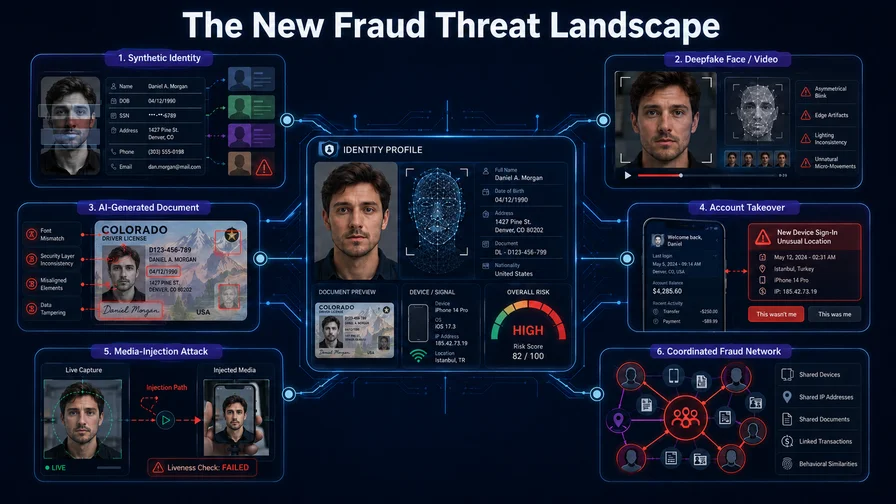
Fraud used to reveal itself through imperfections. A forged document contained a poor-quality logo. A photograph had visible editing marks. A stolen account behaved so differently from its owner that a fixed rule could stop it. Those signals still exist, but sophisticated attacks no longer depend on obvious mistakes.
Synthetic identities combine real and invented information to create an identity profile that can survive basic database checks. The U.S. Federal Trade Commission describes the pattern as a mixture of genuine and fictitious data—such as a real identifier paired with a false name—which can make the resulting fraud harder to discover. The identity may be cultivated gradually, used across several accounts, and supported by a growing collection of internally consistent documents.
Deepfakes add another layer. Generative AI can produce or alter identity documents, portraits, video, and audio at a speed that turns bespoke deception into repeatable infrastructure. In 2024, FinCEN reported an increase in suspicious activity reporting involving deepfake media, particularly fraudulent identity documents intended to circumvent identity verification and authentication controls. Europol’s 2025 serious and organised crime assessment also warns that AI-powered voice cloning and live video deepfakes are enabling new forms of fraud, extortion, and identity theft.
Then there are injection attacks. In remote identity proofing, an attacker may not present a printed photograph or mask to a physical camera. Instead, manipulated or synthetic media can be inserted into the capture stream itself, making the system receive a fabricated feed as though it were live. ENISA has examined scenarios involving deepfake video injection and manipulated identity-document video, underlining why liveness, capture integrity, and session analysis must work together.
Account takeover creates a different problem. The person may have passed verification months earlier, yet a criminal later gains control through stolen credentials, social engineering, SIM swapping, session theft, or compromised recovery processes. The identity is real. The user behind the activity is not.
And increasingly, these are not isolated attempts. Coordinated fraud networks reuse devices, phone numbers, addresses, documents, biometric assets, and behavioral patterns across many applications. Each case may look plausible on its own. The relationship between cases is where the fraud becomes visible.
Static rules cannot carry that load. Neither can visual review alone.
Why AI alone is not enough
AI is powerful because it generalizes from patterns. That is also where its limitations begin.
A model evaluates an application using signals, relationships, and examples reflected in its training, configuration, and operating environment. When an attack is genuinely novel—or when a legitimate customer falls outside the patterns the system expects—the resulting score may be uncertain, misleading, or confidently wrong. More automation does not remove that possibility. It can scale it.
Consider a proof-of-address document with unusual formatting. The layout might reflect a small regional issuer rather than manipulation. A name mismatch may come from transliteration, marriage, or a compound surname. A customer connecting through a different country may be traveling, working remotely, or using a privacy service. A face capture may fail because of poor lighting, disability, an older camera, or an unstable connection.
None of those explanations makes the case automatically safe. But neither does the anomaly make it fraudulent.
Context decides what should happen next.
AI systems also create a less obvious operational risk: automation bias. Once a score appears precise, reviewers may treat it as objective truth even when the underlying evidence is incomplete. The EU AI Act’s human-oversight framework explicitly warns about the tendency to over-rely on automated outputs. For systems that are legally classified as high risk, Article 14 requires oversight measures that let qualified people understand limitations, interpret outputs, detect anomalies, and disregard, override, or reverse a result.
The important lesson extends beyond any single regulation. Human oversight is meaningful only when the reviewer has enough information and authority to disagree.
A person who merely clicks “confirm” after seeing an AI recommendation is not providing effective oversight. That is a rubber stamp. A genuine human-in-the-loop workflow exposes the evidence, explains the important signals, preserves the wider case context, and allows the reviewer to request another check or change the outcome.
Where AI delivers the greatest value in fraud detection
AI is most useful when it does what machines do exceptionally well: process volume, compare many variables at once, and apply repeatable checks without fatigue.
In a modern fraud stack, that value appears across several layers:
- Identity and document analysis: AI can classify documents, extract data through OCR and MRZ reading, compare fields, inspect security features, validate barcodes, analyze metadata and PDF structure, and detect signs of editing or generation that are difficult to see on the rendered page.
- Biometric verification: Face matching can compare a live applicant with the portrait on an identity document, while liveness and deepfake detection help identify presentation attacks, replays, synthetic faces, and manipulated capture sessions.
- Behavioral and device intelligence: Keystroke rhythm, navigation patterns, IP and geolocation signals, device history, repeated attributes, and unusual session behavior can reveal risk that no document contains.
- Anomaly and network detection: machine learning can analyze transaction patterns, implement anomaly detection to flag unusual transactions, and identify repeated documents, linked devices, shared contact details, clustered identities, and coordinated behavior across cases rather than treating each submission as an island.
- AML and ongoing monitoring: Automated screening can compare individuals, businesses, beneficial owners, and connected parties with sanctions, politically exposed person, watchlist, and adverse-media data, then generate alerts when the risk profile changes.
- Real-time risk scoring: Signals from multiple controls can be combined into a structured assessment within fraud detection systems to assess risk across fraudulent transactions and related events, routing a case toward approval, rejection, enhanced verification, or human review.
This is where automation changes the economics of fraud prevention. It does not ask an analyst to inspect every pixel, field, device event, and screening result manually. It assembles the evidence and makes the abnormal visible.
The goal is not to remove the investigator. It is to give the investigator a better case file.
What human reviewers see that automated systems may miss
Human reviewers are strongest where evidence is ambiguous, contextual, or consequential.
Suppose an AML screen returns a possible match. A model can compare names, dates of birth, nationalities, photographs, aliases, and associated entities at speed. A trained reviewer can then determine whether the similarities are meaningful, whether reliable identifiers conflict, whether the source is current, and whether policy requires escalation. The machine narrows the problem. The person resolves it.
The same principle applies to document fraud. AI may flag a font inconsistency, metadata conflict, suspicious edit history, or reused template. A reviewer can compare that signal with the document’s purpose, issuer, capture method, customer explanation, and other evidence in the dossier. One weak signal may be noise. Four related signals may form a compelling pattern.
People are also better positioned to recognize legitimate exceptions. International onboarding contains name-order differences, multiple scripts, regional document practices, non-standard addresses, and customers whose circumstances do not fit the average case. A rigid system can turn diversity into risk. A capable reviewer can determine whether the variation is explainable and what evidence would resolve it proportionately.
That does not mean people are infallible. Reviewers become tired, apply policies inconsistently, miss technical traces, and bring their own biases. Human oversight therefore needs its own controls within a reviewer-governance framework of internal controls: clear escalation criteria, role-based access, evidence-led checklists, quality assurance, employee training to recognize fraud, access controls that limit who can view or handle sensitive information, and recorded reasons for overrides.
The answer to imperfect AI is not unstructured manual judgment. It is disciplined collaboration.
A risk-based review model: fast for most, deeper when necessary
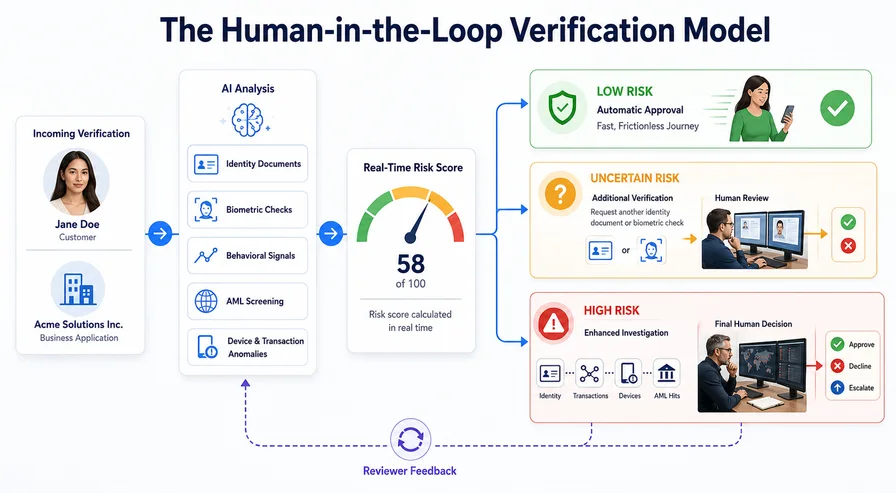
The most practical hybrid model separates cases into three paths.
Low-risk cases can be approved automatically where policy and applicable law permit. The evidence is coherent, required checks pass, no material risk indicators appear, and the model’s confidence meets a threshold appropriate to the use case. These customers should not wait in a manual queue simply because manual review exists.
Uncertain cases should be stepped up. The system may request a clearer capture, another document, NFC chip verification, a liveness retry, proof of address, source-of-funds evidence, or a human review. Uncertainty is not guilt. It is a reason to gather better evidence.
High-risk or high-impact cases should receive enhanced scrutiny. Strong fraud indicators, complex ownership, meaningful sanctions or PEP exposure, conflicting identities, suspected network links, or decisions with serious consequences may require specialist investigation and an accountable final decision.
This structure reflects the logic of the risk-based approach. FATF advises regulated entities to understand the assurance, architecture, and governance of a digital identity system and determine whether it is appropriately reliable for the risks involved. Its digital identity guidance also recognizes that reliable digital ID can support customer due diligence and ongoing monitoring, rather than functioning only as a one-time onboarding check.
Risk-based does not mean relaxed. It means proportionate.
Thresholds should respond to the context: jurisdiction, product, transaction value, delivery channel, document type, customer profile, and the potential harm of a wrong decision, while transaction monitoring helps detect abnormal user behavior after onboarding. A low-value marketplace account and a high-value financial relationship should not necessarily follow identical paths. Nor should a returning customer with stable behavior be treated exactly like a new applicant arriving through a high-risk device cluster.
Human attention is finite. A good system spends it where it changes the outcome. Continuous monitoring can trigger real-time adjustments to authentication methods as risk changes.
Reducing false positives without weakening security against identity theft
Fraud teams live between two costly errors. A false acceptance lets a bad actor through. A false rejection blocks a legitimate person.
Security programs often focus on the first error because its consequences are immediate and visible. Yet false positives have their own compounding cost: abandoned onboarding, lost revenue, repeat support contacts, longer review queues, reputational harm, and unequal treatment of users whose documents or circumstances are less common in the model’s data. Weak controls contribute to nearly half of fraud incidents, and regular reviews are essential for preventing fraud more efficiently.
NIST’s work on synthetic-content detection notes that false positives can lead to serious reputational harm or adverse treatment. In identity and compliance workflows, the practical implication is clear. A risk indicator should initiate the right response; it should not automatically become a final accusation.
Human review creates a pressure-release valve. It lets a business distinguish poor evidence from fraudulent evidence, resolve ambiguous watchlist matches, consider credible explanations, and request the smallest additional check needed to reach confidence. That last point matters. If every uncertainty triggers a complete restart, a technically secure workflow can still become commercially unusable.
Calibration matters too. There is no universal threshold that perfectly minimizes both false rejection and false acceptance. Bynn’s KYC workflow documentation makes that trade-off explicit: organizations can configure risk-based levels, define how uncertain AI outcomes are handled, and route rejected or unclear applicants to manual review or a different risk category. The correct balance depends on the organization’s users, geography, sector, and risk tolerance—and it needs to be revisited as those conditions change, while reducing avoidable manual rework and preventable losses can save businesses time and money.
The objective is not the lowest possible alert count. It is better alerts and better decisions.
Explainability and reporting suspected fraud turn a score into an accountable decision
A black-box verdict creates operational fragility. If an analyst cannot understand why a case was flagged, the business cannot investigate it properly, explain an adverse outcome, test whether a control is performing fairly, or defend the decision during an audit. Clear reporting suspected fraud paths, including whistleblower channels, support accountable decisions and investigation.
Useful explainability is concrete. A review record should show which signals influenced the outcome, how confident the system was, what data and rule versions were used, which evidence supported or contradicted the result, whether a person intervened, and why the final decision was made. “Risk score: 82” is not enough.
Auditability also matters across time. Fraud models, watchlists, policies, thresholds, and customer circumstances change. A defensible record must preserve what the business knew at the moment of decision, not merely what the system shows today.
Data-protection law adds another reason to design for intervention. Article 22 of the GDPR and the corresponding UK GDPR provision place restrictions and safeguards around solely automated decisions that produce legal or similarly significant effects. The UK Information Commissioner’s guidance says organizations within scope should provide information about the processing, offer a simple way to request human intervention or challenge a decision, and check regularly that systems work as intended; the same governance model should also define how suspected internal or external fraudulent activities are escalated and documented.
Not every fraud score or verification workflow falls into Article 22, and not every AI system is high risk under the EU AI Act. Classification depends on the use case, legal role, and effect on the individual. Still, the design direction is unmistakable: traceable evidence, defined responsibility, meaningful review, and the ability to correct a bad outcome are becoming core governance features.
Explainability is therefore more than a compliance document. It improves the investigation itself.
Human feedback should make the system better—carefully
Every reviewed case contains information the original model did not fully resolve. A confirmed fraud attempt may reveal a new document template, injection method, device pattern, or relationship between identities. An overturned alert may show that a rule is too broad. Repeated inconclusive cases may expose a missing data source or an unclear policy. Periodic audits and routine reconciliations can help identify vulnerabilities in financial systems and catch issues preventative controls miss before model updates are made.
That feedback is valuable. But it should not flow blindly into a model.
Reviewer decisions can be inconsistent, incomplete, or biased. Confirmed fraud, suspected fraud, policy rejection, poor-quality evidence, and “not enough information” are not interchangeable labels. A mature learning loop separates them, validates outcomes, measures reviewer agreement, and tests changes before updating production rules or models.
The NIST AI Risk Management Framework’s measurement guidance recommends tracking errors, incidents, pre- and post-deployment performance, emergent risks, feedback, and the effectiveness of controls throughout the AI lifecycle. That is the right mindset for fraud prevention. Models, including those that use artificial intelligence, should be monitored and tested carefully in the environment where they operate rather than updated blindly, because attack patterns, customer behavior, and data quality drift over time.
Continuous learning is not “the machine teaches itself.” It is an evidence-led governance process in which human investigation helps the system adapt without turning every subjective decision into ground truth.
Better security should create less friction for genuine customers
The visible customer experience should be simple even when the analysis behind it is sophisticated.
For most genuine users, AI can complete document, biometric, device, and screening checks in real time. No queue. No unnecessary document request. No analyst waiting to perform a routine comparison that a well-calibrated system can complete consistently. For online accounts, Multi-Factor Authentication adds an extra layer against attempts to gain access with stolen credentials. Enable two factor authentication on your accounts, and avoid public Wi‑Fi when sharing personal information.
Friction should appear selectively. If one signal is uncertain, the next step should address that uncertainty: retake a blurred image, read an NFC chip, perform a stronger liveness check, verify another data point, or send the case to review. The customer should not be forced through unrelated checks simply because the workflow lacks precision.
Human oversight improves experience only if operations are designed for it. Review teams need service-level targets, clear case priority, complete evidence, and the ability to resolve a case without repeatedly asking the customer for information already provided. Otherwise, manual review becomes a holding area rather than a control.
The best hybrid workflow feels almost fully automated to low-risk customers and deliberately human when the situation genuinely needs judgment.
How human-in-the-loop fraud prevention supports compliance
KYC, KYB, and AML controls are not identical, but they share a common requirement: businesses must make risk decisions using reliable evidence and keep those decisions current.
For KYC, that may mean verifying a person’s document, identity data, and biometrics while screening relevant risk sources. For KYB, the work expands to company registration, ownership, control, ultimate beneficial owners, and connected parties. AML adds risk assessment, sanctions and PEP screening, adverse media, escalation, and ongoing monitoring as the relationship changes.
Automation helps apply those controls consistently and at scale. Human oversight helps interpret complex ownership, resolve uncertain matches, conduct enhanced due diligence, document exceptions, and decide how policy applies to facts that do not fit neatly into a rule. Effective fraud prevention strategies should also include organization-wide education about phishing and fraud scams.
The combination also supports data protection and AI governance. Risk-based escalation can limit unnecessary collection by requesting extra evidence only when justified. Defined review roles create accountability. Decision records support audit and challenge. Monitoring helps identify model drift or discriminatory outcomes before they become embedded in thousands of decisions.
Compliance still depends on jurisdiction, sector, product, and the specific obligations that apply. Technology cannot make those legal judgments disappear. It can, however, give compliance teams a clearer, faster, and more controllable way to carry them out while reducing fraud risk through layered controls, documented oversight, and staff awareness.
How Bynn supports a hybrid fraud prevention strategies approach
Bynn brings automated verification, fraud intelligence, and human review into a configurable decision workflow rather than treating them as separate processes.
At the identity layer, Bynn combines document verification with biometric face matching, liveness detection, and deepfake protection. Its identity verification platform analyzes document authenticity and supports adjustable verification steps, while its document-forensics capabilities inspect visible content and underlying file evidence, including metadata, structure, signatures, cross-field consistency, manipulation, and AI-generated content.
Bynn can also incorporate device activity, behavioral anomalies, phone and email intelligence, IP and geolocation signals, repeated documents, biometric mismatches, and network-level fraud indicators. This matters because a sophisticated attack rarely fails in only one place. The document may look correct while the session behavior, linked device history, or reused identity components tell a different story.
For compliance, Bynn connects identity and business verification with AML screening and ongoing monitoring, including sanctions, PEP, watchlist, and adverse-media checks. Its advanced risk-assessment tools allow organizations to set weighted rules, configure thresholds, receive alerts, and manually override risk scores when context supports a different conclusion, helping financial institutions protect customer data, accounts, and money.
The escalation logic is configurable. Bynn workflows can route outcomes to Approve, Reject, or Needs Attention, with the last path designed for cases requiring manual follow-up. Different branches can therefore treat a clean, coherent case differently from one containing ambiguity or a serious risk signal. The platform’s decision-node documentation reflects the core logic of human-in-the-loop fraud prevention: automation handles the path, but uncertainty has somewhere responsible to go.
Bynn’s Agentic Fraud Reasoning adds a further decision-support layer for document review. It can produce a fraud score, suggested decision, confidence level, plain-language reasoning, red flags, supporting evidence, recommendations, and an operator summary. Crucially, Bynn’s documentation states that this AI-assisted assessment does not replace human judgment, that high-risk or unclear results should be reviewed by a person, and that high-impact decisions should not rely on it as the only basis for approval or rejection.
That distinction matters. Bynn helps teams automate analysis, organize evidence, and focus review resources. The business still defines its risk appetite, policies, legal obligations, and final authority.
The result is a more practical operating model: routine cases move quickly, complex cases arrive with richer evidence, reviewers can understand why attention is required, decisions remain traceable, and direct fraud loss and reputational damage can be reduced.
The future is collaborative, not fully autonomous
Fraud specialists are not disappearing. Their work is becoming more focused.
Instead of manually checking every document and clearing repetitive alerts, investigators will spend more time resolving ambiguity, connecting related cases, testing emerging attack methods, tuning controls, investigating high-risk networks, and ensuring that automated decisions remain accurate and fair. AI will absorb volume. People will retain judgment and accountability.
That partnership is necessary because fraud keeps changing. A model trained on yesterday’s attacks needs new evidence. The types of fraud keep expanding, from bank fraud, which involves illegally obtaining money from financial institutions, and credit card fraud, which uses stolen or counterfeit cards for unauthorized charges, to insurance fraud, which involves lying to obtain undeserved insurance benefits, investment fraud, which misleads individuals to invest in non-existent opportunities, and accounting fraud, which misleads investors by falsifying financial statements. These and other common fraud schemes take various forms, which is why hybrid review must keep adapting. A reviewer working without machine-scale analysis cannot see every relationship. Together, they can move faster than either could alone.
The future of fraud prevention is therefore not a choice between automation and oversight. It is a system in which each strengthens the other: AI detects, prioritizes, and explains; humans investigate, challenge, and decide.
Fast where confidence is high. Careful where the evidence is uncertain. Accountable everywhere.